
President at Plum ProExteriors
 08.19.2026
 11 min
 13667
13667
Hardie Board Colors: What Massachusetts Homeowners Choose
Hardie board colors fall into two lines: the Statement Collection, a stocked palette of 24 curated shades, and the Dream Collection, a made-to-order range of nearly 700 custom finishes.
For many homeowners, the Statement Collection is the more practical starting point because stocked colors generally have shorter lead times and may cost less than custom finishes. The Dream Collection is most useful when a project requires a specific or historically appropriate color.
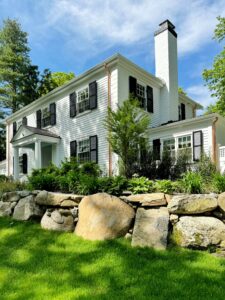
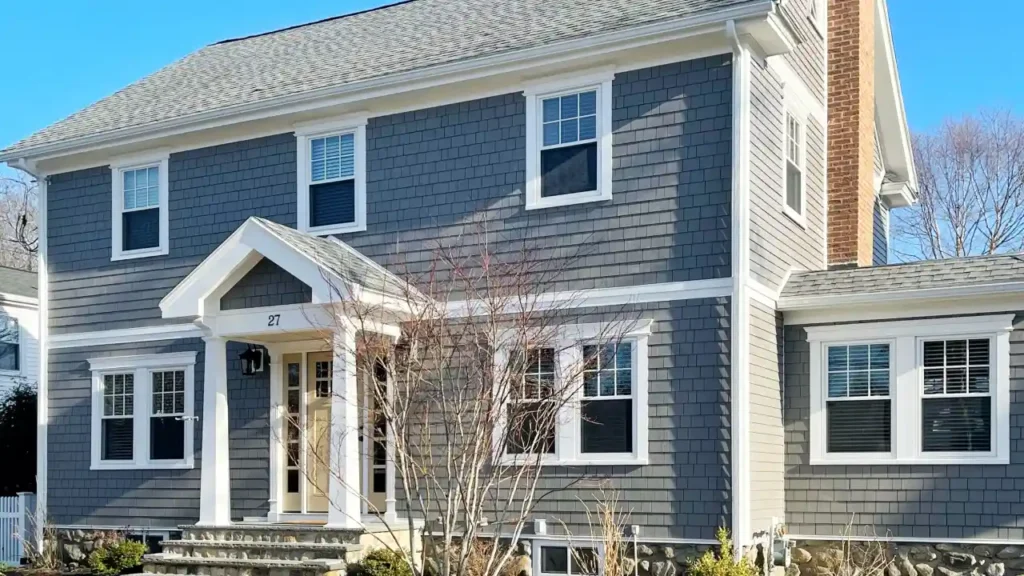
What actually gets installed around here? Plum ProExteriors has put Arctic White on a Southborough colonial, Deep Ocean on an Arlington home, Aged Pewter in Chelmsford, and Awning Blue on the North Shore. Those aren’t catalog guesses. They’re finished elevations weathering the same freeze-thaw cycles your house does.
Before you narrow anything down, it helps to see exactly what’s available in each collection.
What Colors Does Hardie Board Come In?
James Hardie’s color options are organized into two main programs.
The Statement Collection offers 24 curated shades with factory-applied ColorPlus Technology finishes. Familiar options include Arctic White, Iron Gray, Deep Ocean, Aged Pewter, and Cobble Stone. The Dream Collection provides a much wider range of made-to-order colors – nearly 700 made-to-order custom shades in the same coating system. It is intended for homeowners who need a shade that is unavailable in the stocked collection or who want to coordinate the siding with an existing architectural element.
Think of it this way. Statement colors – Arctic White, Iron Gray, Deep Ocean, Aged Pewter, Cobble Stone – are stocked in regional warehouses, which means shorter lead times and lower costs. Dream Collection shades get mixed for your order, so you wait longer and pay a premium, but you can match a historic trim color a Newton or Concord homeowner needs to keep.
Both collections carry the same 15-year finish warranty, which is the part most people miss. The factory finish is baked on, not brushed on, so it holds color through our freeze-thaw cycles far better than field paint. That matters when your south-facing wall takes UV all summer and ice all February.
If you’re still gathering ideas, browsing modern siding style inspiration alongside the palette helps you see how Hardie board siding colors read on a full elevation rather than a two-inch swatch.
Before deciding between the two collections, it helps to know exactly what’s inside the Statement Collection lineup.
Four Popular Statement Collection Colors
These four colors represent only part of the 24-color Statement Collection.
| Color | Overall character | Common architectural fit | Design consideration |
| Arctic White | Bright, crisp neutral | Colonial, farmhouse, traditional | Works with many roof and accent colors but may create a low-contrast exterior when paired with white trim |
| Aged Pewter | Weathered mid-gray | Shingle-style, transitional | Can reveal green or warm undertones depending on the roof, landscaping, and natural light |
| Deep Ocean | Rich navy blue | Coastal, contemporary, traditional | Creates strong contrast with white or cream trim |
| Iron Gray | Deep charcoal | Modern, contemporary, updated colonial | Can appear softer or slightly greener under different lighting conditions |
Twenty more stocked shades complete the 24-color collection, ranging from Navajo Beige to Countrylane Red, and are generally available without the custom-order lead time.
Why does the finish matter? Baked on at the plant, these James Hardie colors carry a 15-year limited finish warranty on paint and labor. Knowing what Hardie board siding is made of explains why that color holds.
Dream Collection And Custom Color Options
The Dream Collection is designed for homeowners who need a color outside the stocked Statement palette. It can be especially useful when siding must coordinate with historic trim, masonry, roofing, or another permanent exterior feature. The Dream Collection is the made-to-order side of the program – roughly 700 custom factory finishes, including Sherwin-Williams and Benjamin Moore matches, carrying the same 15-year ColorPlus warranty.
Custom colors generally require more production time than stocked colors and may carry a higher price.
| Feature | Dream Collection | Primed for Field Painting |
|---|---|---|
| Lead time | Usually longer than stocked colors | Depends on material and contractor availability |
| Finish application | Applied at the factory | Applied after installation |
| Finish warranty | Subject to current ColorPlus terms | Depends on the selected coating system |
| Best use | A defined custom or historic match | Projects requiring a field-applied paint system |
That premium earns its keep in one situation: a documented match. If your Concord or Newton home sits in a historic district with an approved body and trim color, a custom mix beats guessing. Just know that caulking and flashing don’t always have an exact companion shade. Budget accordingly – see cost to install Hardie board siding.
The other route is primed-for-paint siding, like Artisan V-Groove, field-painted in any Hardie board paint colors your local store can mix. You forfeit the factory finish warranty, and you’ll repaint eventually. Understanding how Hardie board is made shows why baked-on beats brushed-on for the colors of Hardie board siding you keep for decades.
Popular Hardie Board Colors in Massachusetts
Arctic White remains a frequent choice in Plum ProExteriors projects. We use it on a Southborough colonial, where bright body and crisp trim kept traditional street character.
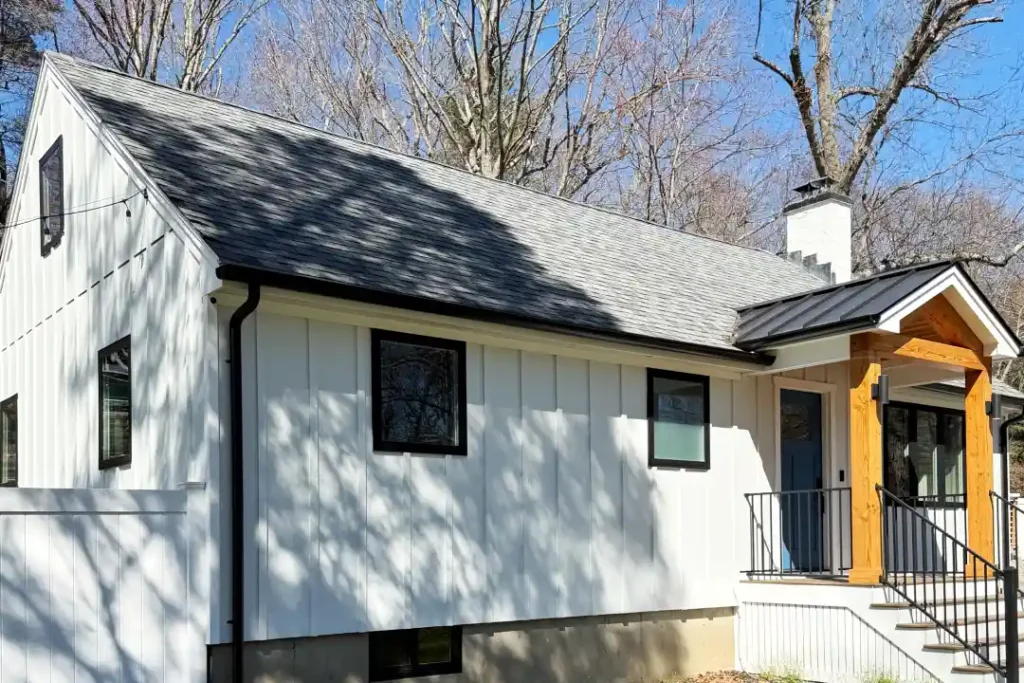
Iron Gray is another popular option and was named James Hardie’s 2026 Color of the Year – a deep charcoal that stands out against gray winter skies. Deep Ocean is navy. An Arlington home paired it with white architectural framing for clean modern New England style.
Warm neutrals like Cobblestone and Aged Pewter, plus greens like Mesa Green, show up on Massachusetts projects in various towns. On the North Shore, coastal blues prove they belong near water.
Which exterior Hardie siding colors suit your street? Compare photos of the colors on real elevations: popular siding colors for New England homes.
Hardie Board-and-Batten Body and Trim Colors
Board-and-batten siding creates regular vertical shadow lines. The relationship between the panel color, battens, window casings, fascia, soffits, and roof therefore strongly affects the completed exterior.
Battens cast shadow lines every 12–16 inches, so trim calms or sharpens that rhythm. Arctic White is forgiving. Match battens to boards? Yes – let the casings, fascia, and soffit carry the contrast. Iron Gray with Arctic White leads 2026; Deep Ocean reads coastal. Quieter? Aged Pewter with Navajo Beige, or Boothbay Blue with Platform Beige.
| Attribute | Classic contrast | Monochromatic | Dark accent |
|---|---|---|---|
| Body color | Bold or deep shade | One warm neutral | Light or white body |
| Trim color | Arctic White | Same as body | Charcoal or black |
| Best for | Farmhouse, colonial | Modern minimal | Contemporary builds |
Matching the battens to the panels allows window casings, fascia, doors, and other architectural details to provide the contrast. Possible combinations include:
- Iron Gray with Arctic White trim
- Deep Ocean with white or cream trim
- Aged Pewter with a warm beige accent
- Boothbay Blue with a soft neutral trim
Board-and-batten materials and installation may also be priced differently from horizontal lap siding. Review the full project cost before committing to a vertical siding design.
How to Choose the Right Hardie Board Color
Start with the house, not the swatch. Colonials and shingle-style homes wear muted neutrals; newer builds carry deep charcoals. Weighing hardie board colors for a center-entrance colonial in Wellesley or Needham? These colonial siding ideas help.
1. Consider the Architectural Style
Colonial and shingle-style homes often work well with whites, muted blues, warm grays, and restrained neutrals. Newer homes may accommodate deeper charcoal, navy, or high-contrast palettes.
These are tendencies, not fixed rules. Proportions, rooflines, window styles, and surrounding materials matter more than the architectural label alone.
2. Identify the Permanent Exterior Materials
Compare potential siding colors with materials that are unlikely to change, including:
- Roofing
- Brick
- Stone
- Foundation materials
- Window frames
- Decking
- Garage doors
A color that looks balanced on a plain sample may shift considerably beside brown roofing, red brick, cool gray stone, or bronze windows.
3. New England Light & Weather
New England light can change how a siding color reads throughout the day and across the seasons. Coastal homes may receive brighter, more open light, while homes surrounded by mature trees often experience cooler shadows that bring out blue, green, or gray undertones.
Winter skies and snow can make dark colors appear sharper, while strong summer sunlight may make the same shade look lighter or warmer. North-facing walls usually receive cooler, flatter light, while south-facing elevations receive stronger sunlight. Mount a full-size board – or the largest sample available – on the house and examine it:
- In the morning
- At midday
- Near sunset
- On sunny and overcast days
- On more than one side of the house
This is the same approach we use when evaluating colors on real Massachusetts projects. Aged Pewter on a Chelmsford home appeared greener beside weathered cedar, while Mesa Green on a Belmont project looked closer to gray beneath heavy tree cover. These shifts were not problems with the colors; they showed why each shade needs to be viewed in place before the material is ordered.
4. Hardie Board Colors Chart and 2026 Trends
Use James Hardie’s official Statement Collection page to review the current color palette, order physical samples, and access the company’s product catalog. Because available colors can vary by region, siding profile, texture, and distributor, enter the project ZIP code and confirm availability with the local contractor or supplier before making a final selection.
James Hardie named Iron Gray its 2026 Color of the Year. The deep charcoal shade is part of the Statement Collection and can be used as either a primary siding color or a darker accent. Its selection suggests continued interest in dramatic neutrals that provide more depth than the whites and pale grays common on many New England homes.
What Massachusetts Projects Reveal About Color Choices
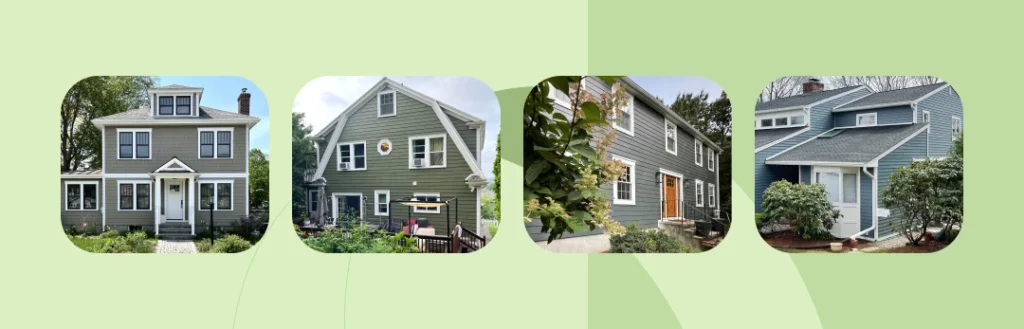
One pattern appears repeatedly in the project examples: a color that looks ideal on a small sample can look very different across a full elevation. On the Chelmsford project, Aged Pewter appeared greener beside weathered cedar. On a Belmont project, Mesa Green appeared closer to gray beneath heavy tree cover.
Neither result necessarily indicates that the color was wrong. Instead, the examples demonstrate why siding should be evaluated in its actual setting before the order is finalized.
Roof color can also influence perception. A warm brown roof may make a cool gray siding color appear warmer, while a dark neutral roof may intensify blue or green undertones.
The most reliable selection process is therefore:
- Obtain large samples.
- Place them beside the permanent exterior materials.
- View them on more than one wall.
- Check them at several times of day.
- Compare the body color and trim together.
Wrapping Up
Hardie board colors come down to three decisions: whether to go stocked or custom, the body-and-trim relationship, and how the shade behaves in real New England light. Get those right, and the rest is paperwork.
The Statement Collection covers most homes with shorter lead times. The Dream Collection exists for the Concord historic district match you can’t find anywhere else. Both carry the same baked-on finish that outlasts field paint through freeze-thaw winters.
Still torn between Iron Gray and Aged Pewter? Order full-size boards, tape them to the wall that matters most, and look again at dusk. That one afternoon saves years of second-guessing. Seeing finished elevations helps more than any swatch card, so scan completed exterior projects for homes shaped like yours.
For deeper reading on siding materials, trim details, and seasonal maintenance, the Plum Pro blog covers it in plain language.
When you’re ready to talk through your palette with someone who’s seen these colors on real Massachusetts houses, reach out to Plum Pro. Call or contact Plum Pro today to get a free estimate on your exterior project.
FAQs
1. What is the most popular Hardie siding color?
Arctic White remains a popular choice, while Iron Gray and Evening Blue have also gained attention. In Plum ProExteriors’ Massachusetts projects, Arctic White and Iron Gray are both frequent choices, depending on the home’s architectural style.
2. What is the color of the year for Hardie board in 2026?
James Hardie named Iron Gray its 2026 Color of the Year. It’s a deep charcoal with a subtle green undertone from the Statement Collection. Paired with Arctic White trim, it reads beautifully on a traditional colonial.
3. Does fiber cement siding affect home insurance rates?
Results vary by insurer. Some offer discounts because fiber cement is non-combustible and hail-resistant; others charge slightly more because replacement costs run higher than vinyl. Call your carrier directly before assuming either way.
4. Can you paint over Hardie board colors?
Yes – a quality exterior acrylic works once the surface is properly cleaned and prepped. Repainting can affect or void the ColorPlus finish warranty, though the fiber cement substrate warranty typically stays intact. Most factory-finished colors don’t need it for years.
5. What colors does Hardie board come in for trim and accents?
Hardie Trim comes in matching ColorPlus finishes across popular Statement Collection colors. Fascia and soffit can be custom-matched through the Dream Collection. White or cream trim against a darker Statement body is a favorite pairing.