
President at Plum ProExteriors
 08.26.2026
 10 min
 13877
13877
When to Replace Siding: A Massachusetts Homeowner’s Guide
When to replace siding? There isn’t one replacement age for every Massachusetts home. Many siding systems last for decades, but material, installation, maintenance, and weather exposure all affect when replacement actually makes sense. Vinyl typically runs 20-40 years, fiber cement 25-50, and wood and cedar closer to 20-30 as rough planning ranges. In Massachusetts, exposure, installation quality, maintenance, and repeated wet/freezing conditions can all affect where a home falls within those ranges.
Why? Freeze-thaw cycling. A wall in Quincy can cross the freezing point dozens of times in a single winter, and each swing works water deeper into failing seams. Add coastal humidity and nor’easter rain and your siding ages faster than the manufacturer’s brochure suggests.
So how do you tell normal wear from a wall that’s actually failing? Start with the signs you can spot from your own driveway.
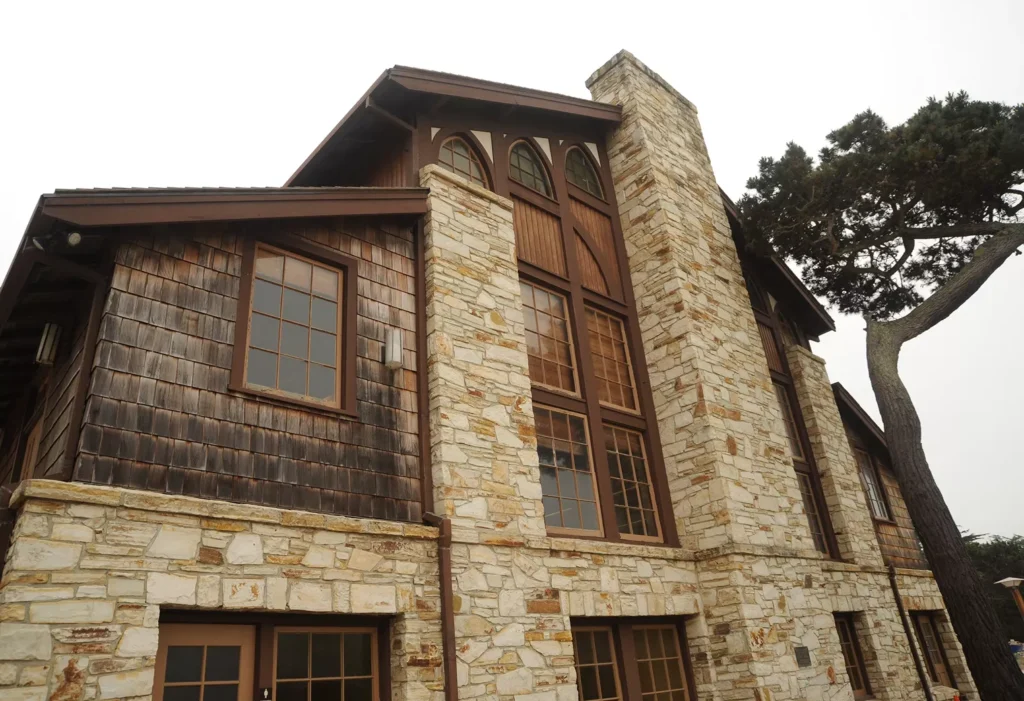
Quick Signs It’s Time to Replace Your Siding
Most homeowners start wondering when to replace siding only after something looks obviously wrong. Here’s the short list:
- Widespread warping or bowing – especially when panels are lifting across more than one area.
- Cracks across multiple boards or courses – isolated damage may be repairable; widespread cracking is a bigger concern.
- Recurring moisture signs – staining, peeling interior finishes, soft material, or damaged sheathing deserve investigation.
- Repeated repairs – if new trouble keeps appearing in different areas, patching may no longer make sense.
- Age plus visible deterioration – older siding isn’t automatically bad, but age matters more once other warning signs show up.
How Long Does Siding Last in New England?
Plan on 20-40 years for vinyl siding, 25-50 years for fiber cement siding, 20-30 years for wood siding, and 30-50 years for aluminum siding. Then shave a few years off the high end of each, because national averages assume gentler weather than ours.
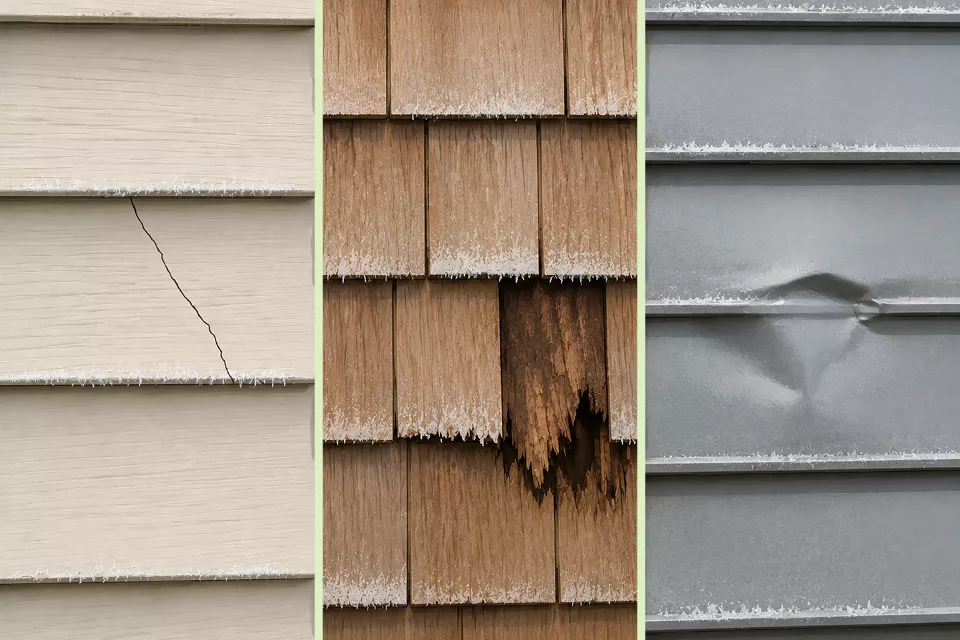
Our winters cross the freezing point dozens of times a season, and each swing expands and contracts whatever’s nailed to your walls. Water sneaks into a seam, freezes, expands, and widens the gap a little more. Vinyl also stiffens in deep cold, so a stray ladder bump in February can crack a panel that would’ve flexed in July.
Coastal humidity does the rest. A house in Scituate taking salt spray and nor’easter rain off the water ages faster than the same house 30 miles inland, especially with wood siding that needs re-staining every five to seven years to stay sealed.
Fiber cement generally weathers our cycles best. Aluminum stays structurally sound but fades. If you’re weighing options, the best siding materials for New England homes are the ones engineered for moisture and movement – and that context shapes when to replace house siding here versus elsewhere.
Let’s break down lifespan by material, starting with the most common in Massachusetts homes: vinyl.
Vinyl Siding Lifespan
Realistically, plan on 20-40 years for quality vinyl siding in Massachusetts, with premium panels reaching or passing the 40-year mark when they’re installed well and washed occasionally.
Installation matters more than most people expect. Vinyl needs room to expand and contract – nail it too tight, and our freeze-thaw swings will buckle it years early. South-facing walls fade first. Shaded north walls often hold color long after.
So when to replace vinyl siding? Once panels crack rather than flex, or when insulated vinyl siding benefits outweigh patching a 30-year-old wall. Cedar and wood siding, common on older Massachusetts colonials, follow a different aging pattern.
Wood & Cedar Siding Lifespan
Expect 20-30 years from wood siding and cedar shingle siding here, and less if staining has slipped. Both need resealing every five to seven years – miss two cycles on a Newton colonial, and you’ll see soft spots at the bottom courses first.
Humidity and driving rain are the culprits. When to replace wood siding usually comes down to the depth of rot, not appearance.
When to replace cedar shingle siding? Once soft spots spread past isolated shingles. Knowing when to replace cedar siding early protects sheathing – worth reviewing siding options for older homes before rot moves inward.
Aluminum siding, another fixture on older Massachusetts properties, has its own timeline worth understanding.
Aluminum Siding Lifespan
Structurally, aluminum siding can go 30-50 years. You’ll find it on plenty of Massachusetts homes built before vinyl took over – split-levels and capes in towns like Braintree still wear it.
The catch is cosmetic. Aluminum doesn’t rot, but it chalks, fades, and dents easily. One hailstorm or a stray branch during a nor’easter leaves permanent dimples across a wall. So when to replace aluminum siding usually isn’t about failure at all. It’s about a house that looks tired, even though the panels are technically fine. Repainting buys time – matching a discontinued profile rarely works.
Beyond age, certain visible red flags tell you it’s time to stop repairing and start planning a full replacement.
Warning Signs Your Siding Needs Replacing
Cracks are the starting point. A single split board is a repair; cracks running across multiple courses mean water is already reaching the underlayment.
Rot and soft spots come next. Press a screwdriver handle against the bottom courses – if the material gives or feels spongy, decay has started, and it spreads quickly into the sheathing and studs. Recurring staining, mold, or mildew deserves a closer look, especially when it appears alongside swollen boards, failed caulk, damaged flashing, or soft material. Surface growth alone doesn’t prove there’s moisture inside the wall, but repeated problems can justify an inspection.
Warping or bowing, panels that curl or lift away, and fading that no longer looks uniform all point the same direction. Then pest entry points. Carpenter ant channels, termite mud tubes along the foundation, or woodpecker holes on a Hingham cape’s cedar all say something soft is behind that surface. Soft, damaged, or hollow-feeling wood can be another reason to have the area inspected.
Finally, higher heating bills. If deterioration extends into the wall assembly or exposes gaps in the home’s air barrier, drafts and energy loss can increase. Any two of these together usually answers when to replace siding on a house rather than patch it.
Once you’ve spotted these signs, the next question is whether a targeted repair still makes sense or if it’s time for full replacement.
Repair or Replace: How to Decide
There’s no single percentage that makes replacement the automatic choice. The decision usually comes down to four things: the siding’s age, the extent of the damage, how much repeated repairs are costing, and how long you plan to keep the house.
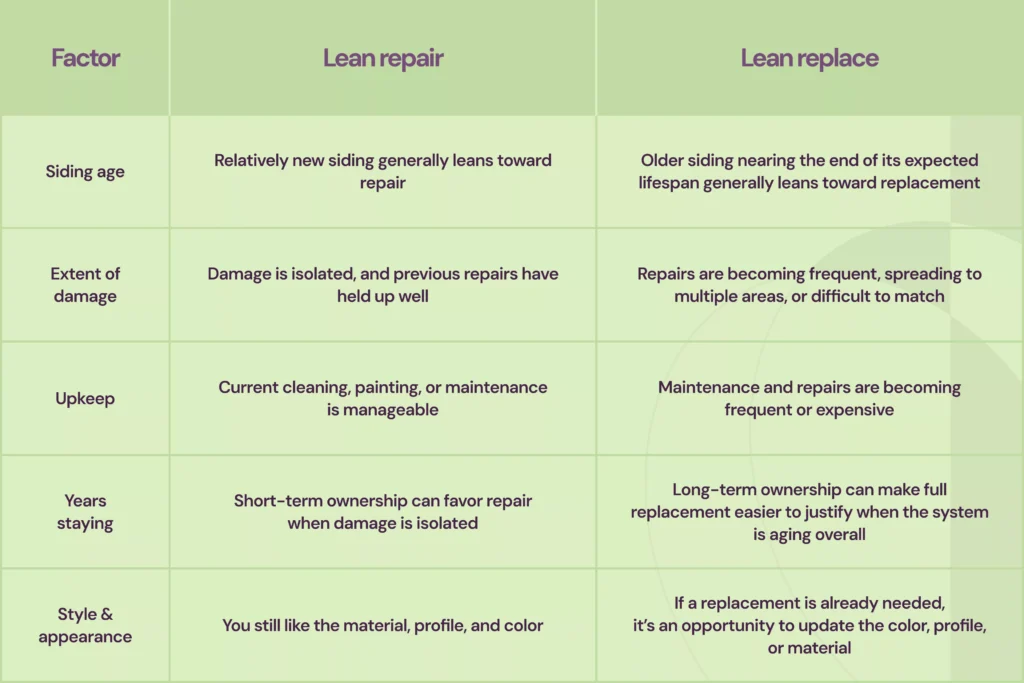
Siding early in its expected lifespan usually deserves a patch, while siding nearing the end of its lifespan usually calls for replacement.
If you’re selling soon, compare the cost of replacement with the condition buyers will actually see. Isolated damage may justify repair; visibly failing siding across the house can become a point of negotiation during a sale.
Cost to Replace Siding in Massachusetts
For a 2,000 sq ft home entered into Plum ProExteriors’ current siding calculator, the estimated vinyl siding totals range from $39,000 to $62,000, based on the project selections used for this estimate.
Simple ranch in Walpole? Lower end. Three-story Victorian with dormers, scaffolding, and cut-up gables? Top of the range or past it.
The calculator uses house size along with project selections to produce a rough estimate, so these totals shouldn’t be treated as universal installed-per-square-foot rates.
For a 2,000 sq ft project, that means:
Standard: 2,000 × $19.56 = $39,120
Premium: 2,000 × $21.47 = $42,940
Deluxe: 2,000 × $31.33 = $62,660
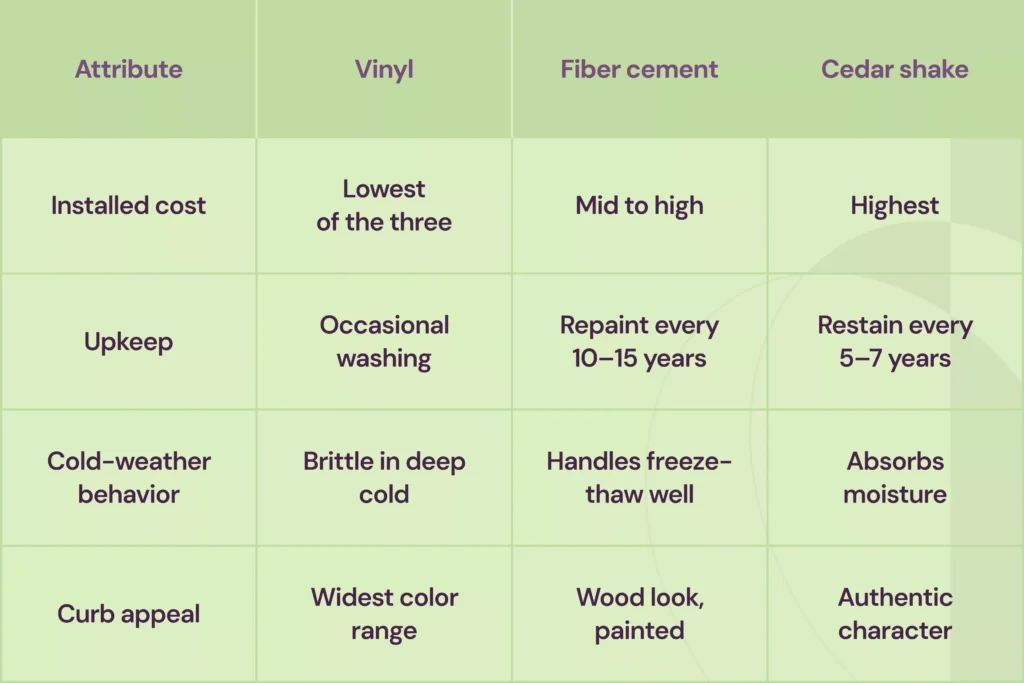
Fiber cement siding costs more than standard vinyl, while cedar typically costs more than that.
Trim work, window wrapping, and rotted sheathing discovered mid-job add cost too, which is why a detailed siding installation cost breakdown beats a per-square-foot guess.
Plum ProExteriors provides no-hidden-fee estimates and offers flexible financing with no down payment through our siding installation services. Call or contact us today for a free estimate on your house siding project.
With a budget in mind, the next step is picking the right material and style for your home.
Choosing New Siding for Your Home
When you’re choosing replacement siding, three common options for Massachusetts homes are vinyl, fiber cement, and cedar shake.
Replacing windows too? You don’t have to do both projects together, but coordinating them can reduce duplicated trim work and make it easier to plan flashing and exterior finishes around each opening.
What Actually Works on Massachusetts Homes
The pattern that shows up again and again across Massachusetts inspections is that homeowners who act while damage is still limited to the siding itself pay far less than those who wait. Once moisture reaches the sheathing behind the panels, the job stops being a siding replacement and becomes carpentry – cutting out soft plywood, sistering studs, sometimes reframing a corner.
How much does that add? Enough that it’s usually the single biggest surprise line item on a mid-project change order. The second thing worth knowing is to schedule a full exterior inspection before committing to a scope. Walking the whole house catches what a homeowner standing at ground level can’t – failed flashing above a bay window, a soft rake board, kickout gaps where a roofline meets a wall.
Think of a 1940s colonial with one visibly rotted corner. Nine times out of ten, there’s a drainage problem feeding it, and fixing only the visible board resets the clock.
Plum ProExteriors provides detailed estimates with no hidden fees, and siding contractors near Brookline, MA can walk your exterior before you decide.
The Bottom Line on Replacing Your Siding
Knowing when to replace siding comes down to the age and condition of the material, the extent of the damage, and whether problems extend beyond the siding into the wall assembly. One cracked panel may be repairable. Repeated failures across several walls make replacement much easier to justify.
Massachusetts weather makes existing defects worth addressing rather than ignoring. Vinyl expands and contracts as temperatures change, and proper installation specifically allows room for that movement. Moisture that gets behind exterior cladding also needs a functioning drainage plane to move safely out of the wall.
Not sure where your home falls? Seeing finished work helps – browse recent siding and roofing projects to picture what a full replacement looks like on a house like yours, whether that’s a Wellesley colonial or a South Shore cape.
If you’d rather read up first, there’s more on materials, costs, and seasonal exterior care over on the Plum ProExteriors blog.
When you’re ready for numbers on your own house, call or contact Plum Pro today to get a free estimate on your exterior project.e? Call or contact Plum Pro today to get a free estimate on your exterior project.
FAQs
1. How do I know when siding needs to be replaced?
Look for warping, cracking, or panels pulling away from the wall. Recurring mold after cleaning, soft spots, unexplained drafts or energy changes, or visible exterior damage are reasons to investigate further. If it’s been more than 20–30 years, get it inspected even if it looks fine.
2. Can vinyl siding last 40 years?
Yes – quality vinyl typically lasts 20–40 years, and premium panels under ideal conditions can last even longer. Our freeze-thaw winters shorten that when nailing is too tight or when panels are installed with insufficient room for normal expansion and contraction.
3. What happens if you don’t replace your siding?
Moisture gets behind the wall and rots sheathing and framing. Drafts widen, heating costs climb, and pests find their way through warped panels. Eventually, the repair bills add up to more than what full replacement would’ve cost.
4. How much does it cost to replace vinyl siding on a 2000 sq ft house?
Using our current calculator, a 2,000 sq ft vinyl siding project comes to about $39,120 for Standard, $42,940 for Premium, and $62,660 for Deluxe. Actual pricing depends on the siding line, tear-off, trim, access, sheathing repairs, and other project details.
5. Do you have to replace siding when replacing windows?
No, they’re separate projects. But doing both together saves labor and gives a cleaner, weatherproof seal at every opening. If your siding is already near the end of its life, combining them usually costs less overall.